

Tottenham, Tudor, and the Signals Everyone’s Ignoring
BallerzBantz Weekly — Issue #1 | Week of March 12, 2026 (Free)
While flying back from the West Coast a couple of weekends ago, I realized that my ideas and ambitions in football had reconciled with the technology of the moment. I’ve spent over a hundred hours since then building a football intelligence system — what eventually became BB:INTEL. At first, I just wanted something to fill in the gaps for the areas I now found most interesting in the sport: strategy, recruitment decisions, the structural patterns that actually determine outcomes. So I scoped out a personal football dashboard — something a director of football or decision-maker would find useful and actionable. After a week of building, I realized I’d inadvertently built the architecture for a public dashboard that is genuinely beautiful and useful. That’s stats.ballerzbantz.com. The build is still ongoing.
This newsletter is the next layer. The dashboard gives you the data. This gives you what it means — the frameworks, the pattern detection, the structural reads that turn numbers into intelligence. Issue 1. Let’s get into it.
– Joel A. A.
Champions League Round of 16 played this week. Arsenal drew at Leverkusen. City were dismantled in Madrid. Chelsea collapsed in Paris. Everyone’s talking about the scorelines. The structures that produced them are more interesting.
Tottenham’s collapse isn’t a form crisis. It’s a structural failure — and the scouting opportunity is hiding inside the wreckage.
Six consecutive defeats. The worst losing streak in the club’s 143-year history. Tudor has lost every match since replacing Frank in February. Tuesday night in Madrid, Spurs went down 5-2 to Atletico in a Champions League tie that’s effectively over — three goals conceded inside 15 minutes, the goalkeeper hooked before the 17th minute.
The Supporters’ Trust is demanding emergency action. Relegation probability sits at 16%. One point above the drop zone. Zero domestic wins in 2026.
Most coverage treats this as a form crisis. It’s not. It’s a structural failure.

The Reverse Engineering framework — BallerzBantz’s model for understanding how clubs and players exploit tactical margins — clarifies what’s happening. Son left for LAFC last summer. Levy resigned in September. Frank was sacked in February after two wins in seventeen. That’s the captain, the chairman, and the head coach — three load-bearing pillars — removed in six months. When that much institutional coherence is stripped from a club, what appears on the pitch isn’t a tactical problem any new manager can solve. It’s a system that no longer has a centre of gravity.
Now here’s the part that matters for intelligence purposes.
The losing streak itself has been widely flagged. The more interesting signal is what happens to young players in the middle of it. From BallerzBantz’s Non-Trivial Scouting Cues framework:
A young player earning significant minutes in a struggling or dysfunctional team is often a stronger indicator of ability than the same minutes at a stable club. In chaotic environments, it would be easy for coaches to shield young players from the mess. If they’re still on the pitch, the coach is telling you something about their floor.
So the question isn’t “will Spurs get relegated?” The question is: which young players are still making the squad despite the dysfunction, and what does their continued deployment tell you about their floor?1 That’s the list agents should be building right now — before the summer, when everyone else will suddenly notice.
One point above the relegation zone. Nine games left. Whether they stay up or go down, this squad will fragment by August. The window for intelligence-gathering is now.
More Non-Trivial Scouting Cues

I am aggregating fundamental team & individual scouting principles I've acquired over the past couple years. This is the second piece of the series.
Sunderland at 40 points is a Coach Trust signal hiding in plain sight.
Sunderland are 11th on 40 points. As a newly promoted side, they’re sitting closer to 7th-place Brentford than to the relegation zone. This isn’t survival. It’s a project that’s working.
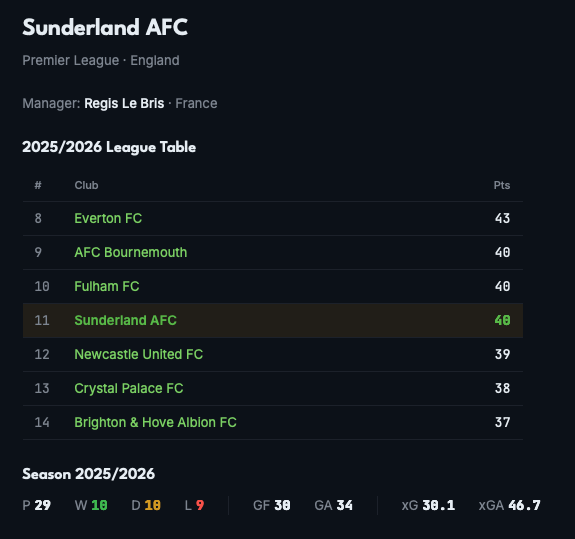
Through the Coach Trust lens — the principle that coaches wield more information about their players than any external observer, and that deployment choices are the strongest available signal — the question becomes: which players have earned consistent selection in a system that’s clearly performing above its expected level?
At a promoted club competing in the upper half, those choices carry even more weight. The coach isn’t rotating to manage minutes for a long European campaign. He’s picking the players he trusts to compete every week in the Premier League. Mapping that consistency of selection against the team’s results produces a clear picture of which profiles are actually driving the overperformance.
For agents with clients who need regular Premier League minutes in a club that’s clearly going somewhere, Sunderland should already be on the shortlist. The players who’ve earned consistent selection there are underpriced by the market, because the market still sees “promoted club” and discounts accordingly.
Managerial changes across six clubs in one season. The Premier League’s coaching carousel is a system, not a series of mistakes.
Forest: Nuno → Postecoglou → Dyche → Vítor Pereira.
Tottenham: Frank → Tudor.
Chelsea: Maresca → Rosenior.
Wolves: Pereira → Edwards.
United: Amorim → Carrick.
The usual take is that individual decisions went wrong. The structural read is different.
The Reverse Engineering framework applied at this scale reveals something about how English football’s ownership class thinks about coaching. It’s not that these clubs hired the wrong people — it’s that the hiring logic itself is broken. When Forest hires and fires four managers in one season, the question isn’t “who should they hire next?” It’s: what institutional problem makes every hire fail?
The practical implication: every managerial change creates a 4-6 week window where deployment patterns reset. New manager, new trust hierarchy. Players who were frozen out get auditions. Players who were starters become vulnerable. Systems tracking deployment consistency — BB:INTEL among them — identify those reset windows as where the intelligence value is highest.
Forest sit 17th on 28 points with Pereira now their fourth manager. Wolves are at 16 points from 30 games — three wins all season, statistically already relegated. The conventional wisdom is “wait for the fire sale.” The intelligence play is the opposite: identify the profiles worth acquiring before the relegation discount makes them visible to everyone else. The young players who’ve kept starting through the dysfunction are the ones to watch. Coach trust is the filter; results are irrelevant for individual evaluation purposes.
Tuesday and Wednesday night produced the sharpest Reverse Engineering contrast of the season.
Arsenal drew 1-1 at Leverkusen — went behind to a second-half corner, rescued it with an 89th-minute Havertz penalty. Controlled, compact, Arteta’s defensive structure holding in a hostile European away leg. Seven points clear at the top of the Premier League, 67 points from 30 games, fewest goals conceded in the league. The narrative keeps circling back to attacking firepower and Haaland comparisons. Arsenal’s edge is structural — defensive consistency is what wins titles in the spring. Through the Anti-Strategy framework, Arteta has built a side that prevents opponents from using their strengths. That’s harder to replicate and harder to scout against than any individual attacking talent.
The same nights: City were demolished 3-0 at Real Madrid — Valverde scored a first-half hat-trick before Guardiola could adjust. Chelsea were beaten 5-2 at PSG — twice came from behind to equalise, then crumbled when the goalkeeper gifted a third. And Tottenham, as discussed, lost 5-2 at Atletico.
Three English clubs with institutional dysfunction — coaching changes, structural incoherence, identity crises — produced three collapses. The one English club with institutional stability and a coaching structure that translates domestically produced exactly what the Reverse Engineering framework would predict: a disciplined, repeatable European performance.
The scorelines tell you what happened. The structure tells you why. Domestic stability is a leading indicator of European performance. Domestic chaos is a leading indicator of European embarrassment.
Beyond the Playbook: The Role of Anti-Strategy in Competition

It's 2.06am in Kansas. I've got my laundry whirling downstairs and watching eager college mates return from their Friday night out, but my thoughts keep on coinciding at these:
From the dashboard
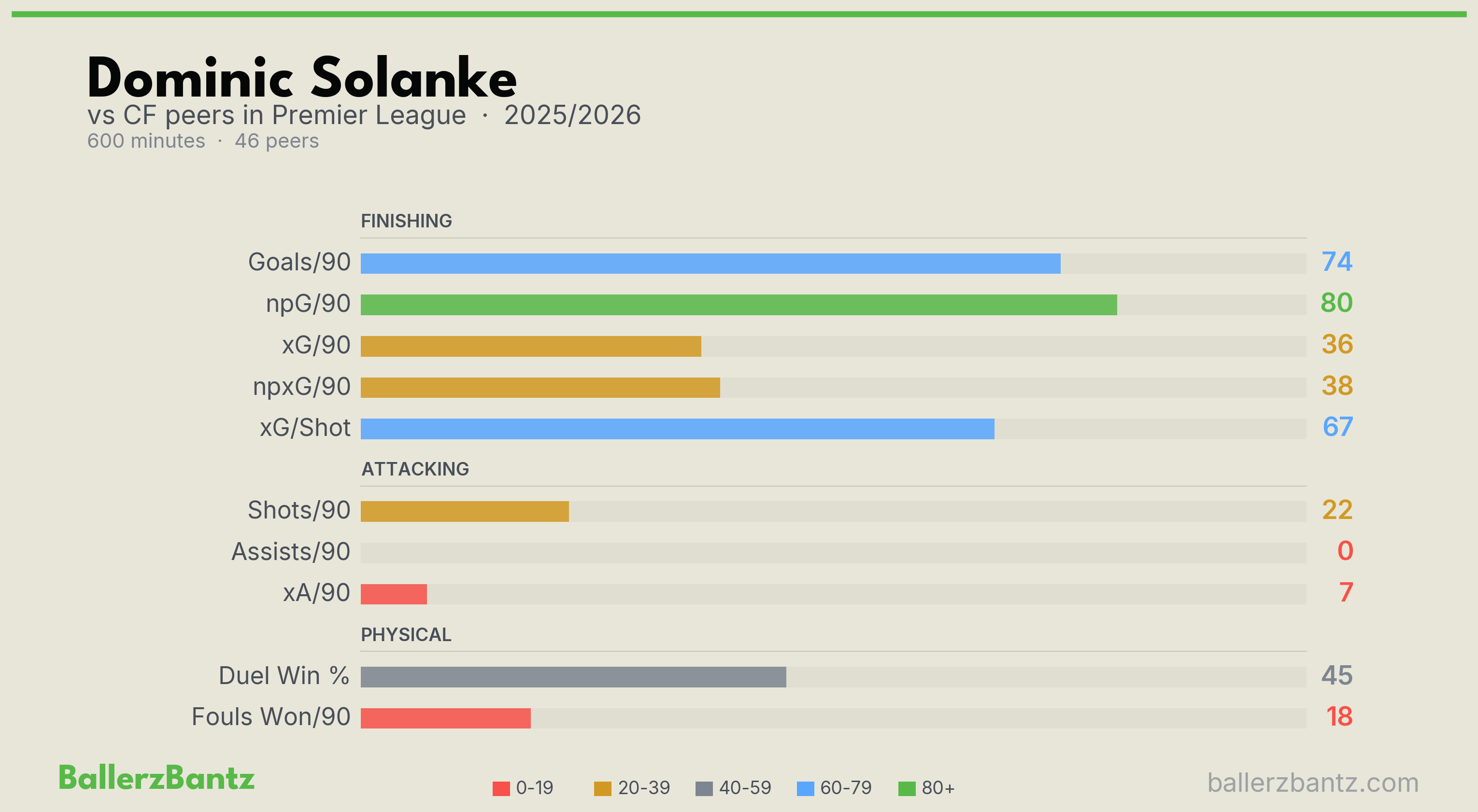
Dominic Solanke scored in both of Spurs’ matches this week — against Crystal Palace in the league and Atletico in the Champions League. Two goals from a striker at a club in institutional freefall. While most of the squad appears disjointed, Solanke’s continued deployment under Tudor and his output in the middle of the chaos is the kind of signal described above. BallerzBantz previously profiled Postecoglou’s signing of Solanke — what it revealed about recruitment principles: character, resilience, tactical compatibility. Worth revisiting now.
Profiling Dominic Solanke with Ange Postecoglou

Ange Postecoglou’s comments after signing Dominic Solanke offer us a clue into the holistic processes guiding elite scouting and recruitment; this essay will examine his words and attempt to uncover some of these underlying principles.
The BallerzBantz dashboard tracks percentile rankings across all five major European leagues — filling the gap left when Opta data was pulled from FBref earlier this year. Full player rankings: stats.ballerzbantz.com/players.
This issue was produced with the help of BB:INTEL, a football intelligence system built from scratch. It tracks 3,100+ players across five leagues, runs 15+ pattern detectors against match data, triages news through 24 analytical frameworks, and surfaces the signals written about here. The public dashboard — with free percentile rankings, shot maps, and scouting data — is live at stats.ballerzbantz.com.
This issue is free. The newsletter moves to paid in the coming weeks — early subscribers who sign up now will get a head start. Bespoke intelligence briefs on individual players and teams are also available on request.
Follow on X: @BallerzBantz | Dashboard: stats.ballerzbantz.com | Briefs: joel@ballerzbantz.com
My thoughts go out to the young goalkeeper Antonin Kinsky (22), who was substituted after a flurry of early mistakes against Atletico. Still — that he earned his way into that XI shows a semblance of trust and training-performance.